

How AI in asylum decision-making drives failure and cost
The use of AI in asylum decisions is meant – according to the Home Office – to save time and money. But it is likely to be doing the opposite.
The use of AI in asylum decision-making
As the United Nations Refugee Agency recently noted, the UK’s asylum application system is under a great deal of stress. Staff morale is low, staff turnover is high, and there is a significant backlog of applications. In order to remedy the situation, the Home Office has introduced time targets (see 9.15) to speed up applications, and introduced the use of AI to create summaries of country information and of substantive interviews with asylum applicants. Just yesterday, the Independent Chief Inspector of Borders and Immigration reported that quantity was triumphing over quality, and showed deep problems with recruitment and training of asylum decision makers.
Our recent legal opinion argued that the use of AI is likely unlawful, especially as asylum applicants are not told about the use of AI in their applications. The problems with using AI is that summaries are likely to contain errors and miss critical information. It is also wholly possible that the case officer does not spend sufficient time engaging with the material. Producing a summary is not done for record keeping alone, but also as a means for the officer to order their thinking, so that they are confident in their decision.
The negative impact of time targets on staff morale is well documented. Layering time targets, AI summaries, poor morale and staff turnover, is an organisationally toxic mix. Furthermore, it pushes decisions into appeals systems, which is itself very expensive, and causes other costs to rise as people seeking asylum are prevented from working and must remain on benefits while a decision is reached.
Systems thinking in the UK asylum system
Thankfully, the government Office for Science has produced an excellent guide for unravelling complex, multi-department problems of this nature, with An introductory systems thinking toolkit for civil servants. This provides very useful mapping tools for policy problems of this nature. We have used one of the visual tools for systems mapping here, to describe the asylum application process.
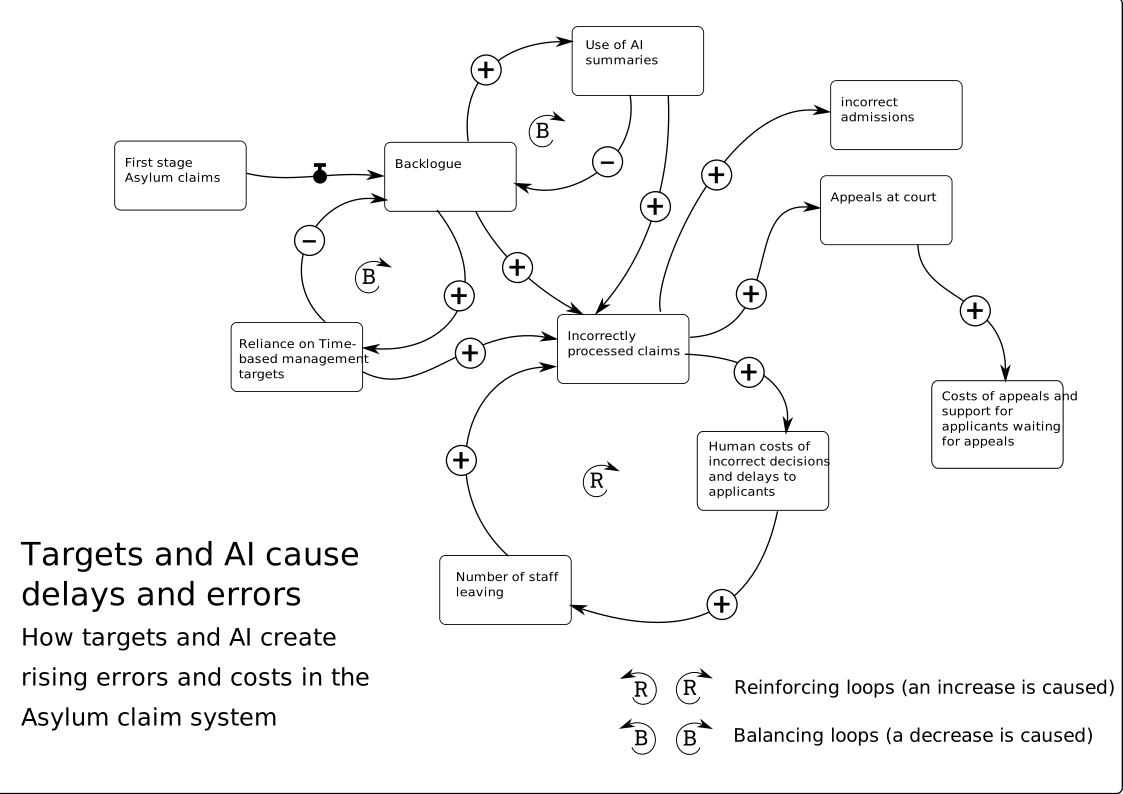
This graph describes our view of how the different components of the current asylum system work together. We sketch out these inter-relationships:
- The use of AI summaries and time targets drives speed up, but reduces the quality of decisions
- The human toll on asylum applicants, who are the most vulnerable in the process, will itself be a demoralising factor for Home Office staff, if they are not allowed to treat them fairly
- Demoralised staff leave, further eroding the quality of decision-making
- The financial costs of waiting for asylum claims to be processed are also a human cost to those whose lives are put on hold, and placed in marginal conditions with limited support
Caught in a doom-loop
The asylum processing system is currently fixed in a doom-loop, where quality and efficiency keep falling. Yet fixing the incentives would be quite easy. The system needs to focus on capacity and the quality of the decision, rather than the speed. With greater capacity, if good decisions are made, the backlog could be reduced, staff retained, and the burden on the courts can be reduced. Rather than inducing highly costly “failure demand” placed on the courts, money spent on getting the decisions right at the start would save the system overall.
Unfortunately, the reason the government is averse to this may be as simple as not wanting to make the wrong “permissive” decision. Or perhaps they do not want to be seen to be allowing a greater proportion of successful claims.
Politically, it has been easier for the Home Office to place the responsibility on the courts. However, this is causing a different kind of political pain as it leads to a higher demand for subsidised accommodation, which has become the target of far right campaigning and violence. Worse, the Home Office responds to this by suggesting the use of military barracks, or other highly unsuitable ‘solutions’ to a problem it has created. And if courts make decisions the Home Office does not like, or admits more people than it would like, then the Home Office is unhappy.
The Home Office responds with more command and control
This desire to control all aspects of the process appears to explain the current proposal to add a new tier to the decision-making process, to replace the current independent Tribunal. As the new appeals process would be within the Home Office, it would be subject to the same political and institutional pressures to reject claimants. The Home Office intends to recruit ex-officers and other non-judicial people that it feels are likely to produce the desired results.
The Home Office’s desire for speed and control is likely to reproduce the same pressure for targets and use of unsuitable AI tools, which may well drive the same problems of lowering quality and sapping morale. Furthermore, the new process is designed to make challenging the decision at court much harder, by introducing judicial review as the standard, which is extremely difficult to challenge. For example, under Judicial Review, decisions are not challenged for being wrong, but incorrectly administered, or “so outrageous in its defiance of logic or of accepted moral standards that no sensible person who had applied his mind to the question could have arrived at it”. This is likely to reproduce conflict in the courts, as groups attempt to address the manifest unfairness of a purely administrative decision-making process. As unfair decisions may stand, the morale of the staff within the new Home Office appeals system may be further sapped. Most people want to believe that they are doing a good job and are helping rather than harming.
In order to address the fraught issue of the costs of the broken asylum process, the Home Office proposes at least some of these should be recouped from successful asylum seekers. That is, the Home Office seeks to charge asylum seekers for the costs of its own failures.
There is a better way forward
But there is another, better solution available. If the Home Office doesn’t want to make the decisions, but does want good administrative decisions, done at a reasonable speed, then it could give the whole process to someone else. In many countries, it is local councils that process asylum claims. In the UK context, a mix of councils, Wales, Northern Ireland and Scotland, and other devolved administrations, could be given these duties. It could invest in capacity to make good decisions, and ensure that decisions allocated resources to difficult cases, and measured success in terms of lower numbers of successful appeals at court.
It is clear that the Home Office could address problems with first stage applications pretty easily, simply by shifting the goal of the system from speed of processing to accuracy and fairness of processing, and applying appropriate resources. This would remove huge emotional costs to people seeking asylum, and to Home Office staff, while also massively reducing financial costs to the government.
However, instead of fixing the problem, the government is choosing to rig the system in favour of the Home Office’s preferred outcomes, by limiting the appeals system in order to reduce the numbers of successful appeals, and by loading some of the financial costs onto the people obliged to use the system. The initial decision process stays in place, broken and unfixed. The risks to asylum seekers from bad decisions, and to society at large of tolerating government bodging legal processes, towards particular unfair outcomes, is nowhere in sight. The same incentives for target-driven processes, AI for supposed efficiency, and failure are left in place and made worse. A worse way of addressing the problems the Home Office has generated would be hard to find.