
Digital Privacy
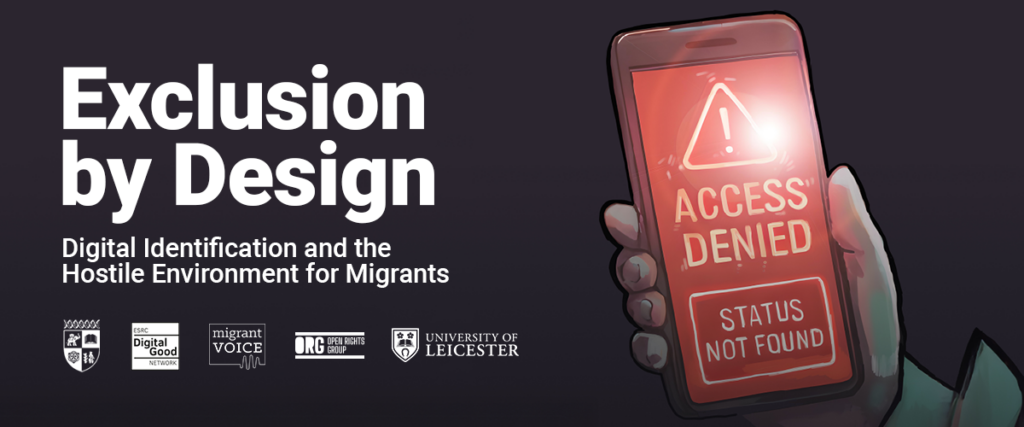
Exclusion by Design: Digital Identification and the Hostile Environment for Migrants
The debate over digital ID systems has recently intensified in the UK, with Prime Minister Keir Starmer framing digital IDs as a mechanism to curb ‘illegal working’. What these debates often overlook is that the UK has already introduced a ‘digital immigration status’ – first via the EU Settlement Scheme (EUSS) and then the eVisa – which requires migrants to prove their legal status through digital means only.
From 1 June 2025, nearly all migrants entering or legally residing in the UK must obtain an eVisa to prove their rights. This makes migrants the first group to experience a mandatory digital-only identification system, effectively positioning them as a testing ground for broader national digital ID ambitions.
READ THE Full report
Exclusion by Design: Digital Identification and the Hostile Environment for Migrants.
Ozkul, D. & Godin, M. (2025). In collaboration with Nazek Ramadan and Anne Stoltenberg (Migrant Voice) and Sara Alsherif (Open Rights Group).
About Digital immigration status
The UK’s transition to a digital immigration status began with the EUSS in 2018. The rollout of digital-only status faced criticism due to issues such as digital exclusion, accessibility barriers, and frequent technical failures that hindered migrants’ ability to work, rent, travel, and access public services.
Despite these concerns, the Home Office continued with the full digitalisation of its system. The eVisa rollout for non-EUSS migrants started in late 2023. However, due to inadequate preparation, the transition deadline was postponed twice. Initially set for December 31, 2024, it was first extended to April 1, 2025, and later moved to June 1, 2025, with physical documents, such as Biometric Residence Permits (BRPs), no longer valid for travel.
As digital status has become mandatory for most migrants, it is important to understand its implications for their lives. It’s equally important to examine how this digital system influences the broader population, especially those tasked with verifying migrants’ statuses through right to work, rent, travel checks, as well as access to public services and educational institutions. This report addresses this gap by examining the experiences of migrants of diverse nationalities, legal statuses, family situations, and migration trajectories across the UK. It investigates digital immigration status as a wider ‘digital identity platform’ that reshapes the UK’s border regime and produces new forms of ‘everyday bordering’. The analysis explores how migrants understand, access, and navigate their digital status; how reliably they can generate proof of their rights; and how the transition to a digital immigration status impacts their everyday lives, their socio-economic conditions and well-being.
The central research question in this report is the following:
How has the digitalisation of immigration status, particularly the implementation of the eVisa system, affected migrants in the UK?
This report is the result of more than a year-long collaborative effort between academic researchers, Migrant Voice and the Open Rights Group, employing various methods (FOI requests, roundtables and semi-structured interviews) to explore migrants’ experiences with digital immigration status.
Drawing on in-depth interviews with 40 migrants in the UK, this report examines digital immigration status from the perspective of those directly affected. It explores how migrants, third-party actors, and the technical design of the system, conceptualised as a ‘digital identity platform’, interact to shape migrants’ experiences and shifting positionalities. Our findings show that the digitalisation of immigration status has had predominantly negative impacts on participants, though the nature and consequences of these effects vary across individuals and contexts.
A systematic and inductive analysis of interviews revealed a set of recurring themes. These insights were organised into three overarching categories:
- Emotional and affective experiences;
- Practical experiences, including both positive and negative elements, as well as key obstacles and challenges encountered; and
- Coping strategies employed by migrants to navigate and mitigate these difficulties.
Emotional and affective experiences
Many participants reported experiencing high levels of stress, fear, and exhaustion while attempting to digitalise their immigration status within short and shifting deadlines. Changes to timelines and limited guidance intensified uncertainty, contributing to widespread anxiety. In contrast, migrants who had more positive practical experiences of digitalising and using their status reported lower stress levels and greater confidence. This report demonstrates that system design and access to resources, as well as an element of ‘luck’ in not encountering technical glitches, play a crucial role in shapin overall perceptions.
A general sense of confusion was evident among many migrants who were unaware that they would need to navigate this process on their own and lacked a clear understanding of how the system operates. These emotional responses were closely tied to practical barriers, including unclear instructions, system errors, difficulty accessing accounts, and the complexity of managing the digital platform across multiple family members.
Worries of being unable to prove legal status – within a hostile environment that emphasises enforcement, detention, and deportation – were pervasive. As a result, the inability to quickly and easily prove legal status causes significant harm.
A deep fear of losing their rights if they made mistakes within the digital portal was shared among our participants. Because the system requires migrants to regularly update their information, even minor or inadvertent errors were perceived as potentially jeopardising their status. This created a persistent sense of vulnerability. Moreover, the burden of managing these risks and the anxiety associated with them falls entirely on migrants.
A profound sense of exhaustion with the Home Office and its immigration policies was shared. Migrants were required to navigate multiple components of the immigration system, digitalise thei status, and use it in various aspects of daily life, while some also faced the challenge of resolving technical issues – all of which contributed to this pervasive sense of fatigue.
A deep sense of mistrust toward the Home Office shaped migrants’ experiences, especially those with negative encounters, who therefore often avoided engaging with official updates in order to protect their well-being. At the same time, many felt that the shift to digital status served primarily to increase control rather than improve fairness and efficiency. The absence of meaningful consultation or accessible information sessions reinforced the perception that migrants’ needs and perspectives were overlooked.
Practical experiences
A closer look at participants’ accounts about their use of the system reveals that problems can be clustered around three primary sources: (1) flaws in the design of the system itself, (2) difficulties rooted in individual circumstances and resources, and (3) the lack of knowledge by third-party actors who need to comply with the new system. Importantly, these categories often intersected, meaning that migrants with fewer resources were hit hardest when design flaws occurred.
Flaws in the design of the system itself
A key finding of our study is that many of the challenges faced by migrants were directly linked toflaws in the design of the digital immigration system. Participants reported difficulties arising from overly complex processes, technical glitches, incorrect or entangled data, and challenges related to generating share codes. Additional barriers included device-specific limitations, unclear or inconsistent communication from the Home Office, reliance on specific documents, and problems associated with legacy documents. These design-related issues significantly impacted migrants’ ability to navigate the system, contributing to stress, confusion, and delays.
Difficulties rooted in individual circumstances and resources
The data shows that the system was particularly difficult to use for migrants with limited access to resources and challenging individual circumstances. Key factors included varying levels of digital and English literacy, limited access to devices and reliable internet, caring responsibilities and associated time pressures, disabilities or age-related limitations, and complex legal trajectories in the UK. These personal and contextual conditions significantly affected participants’ experiences and their ability to navigate the system.
The role of third party actors
A further set of challenges emerged from migrants’ interactions with third-party actors who play a critical role in implementing and enforcing the digital immigration system. Participants reported numerous difficulties when digitalising their status and generating share codes, which had direct consequences for their right-to-work checks, right-to-rent checks, and travel to the UK. Those who relied on the system most frequently, such as individuals applying for multiple short-term jobs or seeking housing due to frequent relocations, were disproportionately affected.
Third-party actors, including employers, landlords, airline carriers, and border officers, displayed varying levels of awareness and understanding of the system, creating uncertainty and additional. burdens for migrants.
- Right-to-work checks: Participants encountered outdated or incorrect share code information, lacked clear guidance for themselves and employers, faced requests for share codes early in the hiring process, and experienced having to repeatedly explain the system to employers. Technical issues and concerns about triggering immigration enforcement added further anxiety, sometimes leading migrants to avoid salary increases or contract changes.
- Right-to-rent checks: Landlords’ limited awareness of share codes and inconsistent government communication, coupled with system failures during code verification, created stress and delays for migrants seeking housing.
- Travel to the UK: Many participants reported difficulties and fears when using share codes for travel. Challenges included some airline and border staff’s unfamiliarity with eVisas, repeated requests for new share codes, poor internet connectivity, and system errors. Additional issues included linking digital status to passports and the fear of being denied re-entry, both of which discouraged travel altogether.
Our study shows that many third-party actors lack a sufficient understanding of the share code system, leading, in some cases, to outright refusal to engage and to the effective exclusion of migrants. Migrants frequently relied on the goodwill of third-party actors to resolve technical problems. When third-party actors lacked adequate knowledge about the digital immigration status, migrants had to explain the process, creating an additional and often uncertain burden.
We also identified instances of unlawful or unintended uses of the system, which can be seen as emerging forms of ‘casual surveillance.’ For example, supermarket staff requested share codes as proof of identity – assumedly, well beyond the Home Office’s intended purposes. Such practices expose migrants to more everyday racism and social exclusion, limiting access to everyday goods and services, and demonstrating that the risks of digital status extend far beyond official enforcement contexts.
Coping strategies
Migrants employ a variety of strategies to mitigate the challenges and potential harms caused by the new digital immigration system. These strategies operate across multiple levels – individual, social, and institutional – and reflect both practical and creative responses to a system that many experience as complex, stressful, and exclusionary. At the individual level, migrants develop contingency measures, such as maintaining a portfolio of digital and physical proofs of legal status, to avoid errors that could jeopardise their rights. These practices demonstrate resourcefulness and a proactive approach to navigating systemic risks. At the community level, migrants rely heavily on informal networks, including friends, family, and community WhatsApp groups, to share guidance, clarify complex rules, and collectively try to resolve problems. Social media platforms such as Instagram, YouTube, and Reddit – often run by migrants themselves – have become critical resources for support, and peer-to-peer information sharing. At the institutional level, strategies range from attempting to use official Home Office channels, sometimes with limited success, to reaching out to migrants’ rights networks, legal aid organisations, and other migrant support groups to address the shortcomings of official guidance.
Despite these adaptive strategies, the system continues to generate stress, uncertainty, and mistrust. Migrants’ reliance on personal and community resources highlights both the resilience of migrant networks and the systemic shortcomings of the digital immigration status system. Overall, these strategies reveal how migrants actively navigate the digitalisation of immigration status, often shouldering a disproportionate burden in managing their own legal security.
Last but not least, it is important to highlight that this research was conducted during the transition phase when the Home Office had announced grace periods, with migrants still being able to use their physical documents until 1 June 2025. The full consequences of digitalisation and its impact on migrants’ lives are only beginning to emerge. Based on the problems reported, the implications are likely to get worse. This misuse of the ‘share code’ system by individuals who are not entitled to access it, including, for example, shop workers, is hugely worrying, particularly in an environment already marked by hostility toward migrants. When such practices occur in a politically divisive context where migrants are routinely scapegoated for broader social and economic issues, the consequences can be severe, with migrants at even greater risk of racism, criminalisation and discrimination.
Policy Recommendations for the Home Office
The transition to a fully digital immigration status system marks a significant shift in how migrants interact with the UK’s immigration infrastructure. While digitalisation is being presented as a modernisation effort aimed at improving efficiency and security, our research demonstrates that its current implementation has created substantial barriers for many migrants. These include individuals with limited digital literacy, language proficiency, or access to technology, those navigating complex legal trajectories, as well as many others who faced various types of technical glitches and errors.
These challenges have resulted in legal uncertainty, emotional distress, and social exclusion from essential aspects of daily life, including employment, housing, access to public services and travel.
The following recommendations aim to address these systemic shortcomings and ensure that the digital immigration status system operates fairly and in a manner that safeguards the rights and dignity of all migrants. The recommendations are organised into three categories: Immediate Actions, Short-Term System Changes, and Long-Term Reforms, reflecting both urgent priorities and structural changes required for sustainable improvement.
Immediate Actions to Improve the Digital Immigration Status System
Provide accessible support services
Establish support services for migrants experiencing difficulties with digital immigration status, including freely available interpretation. These services should be accessible through direct Home Office channels, such as a 24/7 helpline staffed by fully trained officers, and through nongovernmental organisations, supported by a clear and sustainable funding model beyond current short-term arrangements.
Provide multilingual guidance
Ensure all guidance materials, including UKVI account instructions and website content, are available at least in the most spoken languages among migrant communities in the UK.
Inform those responsible for status checks
Employers, landlords, educational and banking institutions, government agencies, airline carriers, and UK and overseas border authorities must be fully informed about the digital immigration status system and provided with appropriate support. This should include a 24/7 helpline to resolve system errors in real time.
Provide rapid remedies for technical glitches and errors
Implement fast and effective procedures to correct inaccurate data, ensuring individuals do not lose access to employment, education, housing, services or travel due to system failures.
Short-Term System Changes
Standardise share code
Eliminate the use of multiple share codes for different purposes, as this creates confusion and complicates practical application.
Ensure inclusivity in system design
Redesign the digital immigration system to remove practical and structural barriers, enabling migrants to view, verify, and update their status without needing advanced digital skills. The system must be accessible to individuals with disabilities, including those who are visually impaired.
Provide non-digital alternatives
Recognise that digital systems cannot be fully inclusive due to factors such as digital literacy, lack of connectivity, or technical failures. The Home Office should provide robust non-digital alternatives for registration, application, and status verification through freely available in-person appointments. Physical proof of immigration status should be available alongside digital options, ensuring individuals can demonstrate their rights even when offline. Maintaining non-digital alternatives is crucial to safeguarding access to rights and essential services. A hybrid system that combines digital and physical proof should be available to all.
Protect privacy through data minimisation
Restrict the sharing of personal information with third parties to what is strictly necessary (e.g. confirmation of right to work, rent, or travel). Sensitive details, such as visa category or refugee status, should not be disclosed to prevent discrimination. The right to privacy is a fundamental human right and must be upheld.
Ensure transparency
Publish clear and accessible information for migrants on what data is stored, how it is managed, and which government agencies and external parties have access to it. The Home Office should also publish unredacted, regularly updated Data Protection Impact Assessments (DPIAs) and Equality Impact Assessments (EIAs) for the digital immigration system (including both eVisa and the EUSS). Additionally, statistics on reported technical issues and remedial actions should be made public.
Create appeal and redress mechanisms
Establish accessible and robust procedures for migrants to challenge harms caused by technical error or system inaccessibility. The Home Office should take full responsibility for losses arising from system failures and amend the ‘UKVI Account Terms and Conditions’ to remove the current exclusion of liability clause.
Long-Term Reforms
Transform the transactional nature of status generation
Currently, migrants must generate temporary share codes to verify their legal status requiring repeated actions throughout their residency. The system should be reformed so that status remains fixed and stable for the duration of granted rights, eliminating the need for continuous code generation and providing security and certainty for migrants.
Establish meaningful two-way communication with civil society organisations
Ensure that engagement with civil society organisations is not limited to one-way information sharing but fosters genuine dialogue. The Home Office should actively listen and respond to concerns raised by these organisations, including calls for formal investigations into GDPR compliance and the equality implications of the digital immigration status system.
End the digital hostile environment
Terminate policies that outsource immigration checks to third parties such as employers, landlords, local authorities and educational institutions.
Prevent unlawful status checks and casual surveillance
Introduce clear legal safeguards to prevent individuals or organisations, such as shop staff or political activists, from demanding proof of digital immigration status without lawful authority. Those engaging in such practices should face appropriate penalties. The Home Office should provide clear guidance on unlawful checks.
Stop experimental technology use on migrants
Migrants have a particularly vulnerable position, often without clear appeal mechanisms. Immigration systems should not serve as testing grounds for unproven technologies.
Reframe the narrative and practice of technology use
Shift the narrative and use of technology in immigration from enforcement and surveillance toward enabling efficient access to essential services. Digital tools should be designed to facilitate inclusion and service delivery, not to monitor or penalise individuals.
Implementing these recommendations would significantly reduce the risks and inequities created by the current digital immigration system. By prioritising accessibility, transparency, and accountability, the Home Office can ensure that the digitalisation of public services does not compromise migrants’ rights. Failure to act will perpetuate systemic exclusion, deepen inequalities, and erode trust in public authorities.