
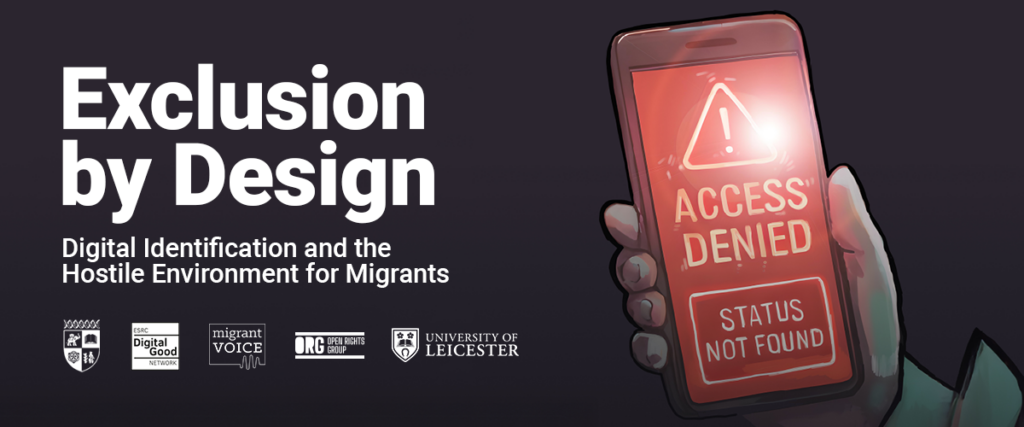
Stressed, Fearful and Excluded: New research exposes harms of digitalising immigration status
- New report finds that the Home Office’s digital-only immigration status system is leaving migrants in the UK stressed, confused and fearful.
- Digital status does not affect all migrants equally: those with limited digital literacy, language barriers, disabilities or a lack of access to the internet experience more exclusion.
- One interview raised concerns about ‘mission creep’ where migrants could be asked to share immigration status beyond legal requirements.
Report: exclusion by design
Digital Identification and the Hostile Environment for Migrants.
Read the reportNew research warns that the digitalisation of immigration status system is causing stress, confusion, and exclusion and placing an unfair burden on migrants to navigate a complex system and resolve errors and glitches that are beyond their control.
Exclusion by Design, Digital Identification and the Hostile Environment for Migrants was produced by Derya Ozkul (University of Warwick) and Marie Godin (University of Leicester/Oxford) in collaboration with Nazek Ramadan and Anne Stoltenberg (Migrant Voice) and Sara Alsherif (Open Rights Group).
The digitalisation of immigration status began in 2018 and is now mandatory for the majority of migrants. It affects their daily lives, including their ability to work, rent or buy a house, travel, study and access public services. Most migrants involved in the study had negative experiences of digitalisation.
Key findings from the research
- Participants reported high levels of stress, fear and exhaustion as they attempted to navigate unclear guidance, shifting deadlines and frequent technical problems. This was made worse by inadequate support from the Home Office.
- Many expressed deep anxiety about making minor mistakes, fearing it could jeopardise their rights. This sense of vulnerability is heightened by the wider hostile environment.
- A recurrent theme was exhaustion with the Home Office’s policies and processes. Participants described having to navigate both the complex process of digitalisation and then having to work out how to use their digital status in their daily lives.
- The digital platform’s design flaws, including technical glitches, data errors and unreliable share codes, were a major source of harm. Some participants reported losing access to employment; others had problems traveling to the UK.
- Migrants with limited digital literacy, language barriers, disabilities and caring responsibilities were most harmed.
- Migrants relied heavily on personal networks, community groups, and migrant-led online platforms to navigate the system due to inadequate official support.
- Migrants frequently encountered employers, landlords, airline carriers, and border officials who lacked understanding of share codes or digital immigration processes. Some reported having to explain the system to employers and landlords themselves, revealing significant gaps in official communication and training.
Unintended mission creep
One participant revealed that a supermarket worker asked them for a share code to prove their age even though they had already presented another form of ID. While this was only one case among 40 interviews, it raises concerns that as there is growing public awareness of E-visas and share codes, migrants will be asked to prove their right to be in the UK in situations where this is not necessary. This could be an unintended consequence of expecting employers, landlords and others to act as an arm of the state. In addition, digital ID is being proposed for everyone in the UK expressly to cut down on ‘illegal migrants’. Against this hostile political and media environment, it is foreseeable that migrants could be racially profiled on a daily basis and expected to prove their right to be in their UK by members of the public who have no right to make such a demand.
Quotes from research participants
‘I think with the Home Office it feels like, “oh, the digital is done and our job is done”. No, your job is not done if it is not working properly.’
‘When I gave them a new share code, they told me that it still said I could just work for only 20 hours a week. So I don’t know what exactly was wrong, but it shouldn’t have said that because I was eligible to work full-time. So I couldn’t get that job.’
Quotes from report authors
Dr Derya Ozkul from the University of Warwick said:
“In our research, we heard from individuals losing employment opportunities, missing flights, having their personal information shared with others, struggling to complete processes due to technical issues, and worrying that they had lost their legal status. We also heard from people being questioned and asked to provide their share code in situations where it was not required. This report should serve as a warning to everyone about what can go wrong when systems are made compulsory and digital-only, without offering any alternatives.”
Nazek Ramadan, Director of Migrant Voice said:
“The findings of this report clearly show how the design and implementation of digital only status are preventing migrants from demonstrating and accessing the rights they already have. This is why the whole system needs to be reformed to enable migrants to access their rights, rather than creating structural barriers which lock us out, and lead to discrimination; stop outsourcing immigration checks to third parties, and shift the narrative from surveillance and enforcement to inclusion and service delivery.”
Marie Godin, from the University of Leicester said:
“Our report highlights the experiences of migrants across the UK – of different nationalities, legal statuses, and family situations – who were forced to adapt to the new system with little time or support. Many described confusion and anxiety as they navigated a complex, glitch-prone platform, fearing that even small mistakes could cost them the right to work, rent, or travel. The constant pressure to manage their digital status and fix technical issues left many exhausted, reinforcing migrants’ perceptions that the shift to digitalisation prioritised control over fairness, efficiency and accessibility.”
Sara Alsherif, Migrants Digital Justice Programme Manager at Open Rights Group said:
“A year after it was supposed to come into effect, the eVisa system is still beset with problems. This research highlights the human cost of these hostile digital systems that are flawed by design.
“The Home Office can take immediate steps to reduce the anxiety that migrants are experiencing by giving them the safety of a physical or digital back up that will allow them to prove their status in any circumstances.
“However, root and branch of reform of this system is also needed and lessons must be learnt, especially as the government intends to roll digital ID out to everyone in the UK.”
About the research
The research was carried out by Derya Ozkul (University of Warwick) and Marie Godin University of Leicester/Oxford) in collaboration with Nazek Ramadan and Anne Stoltenberg (Migrant Voice) and Sara Alsherif (Open Rights Group). The researchers used various methods including FOI requests, roundtables and in-depth interviews with 40 migrants from across the UK.
The research was carried out before June 2025 when physical documents could still be used. With full digitalisation now in effect, the report warns that harmful consequences are likely to intensify. The experiences of migrants also forewarn of some of the problems that will occur when the Government rolls out plans for digital ID to all UK citizens.